
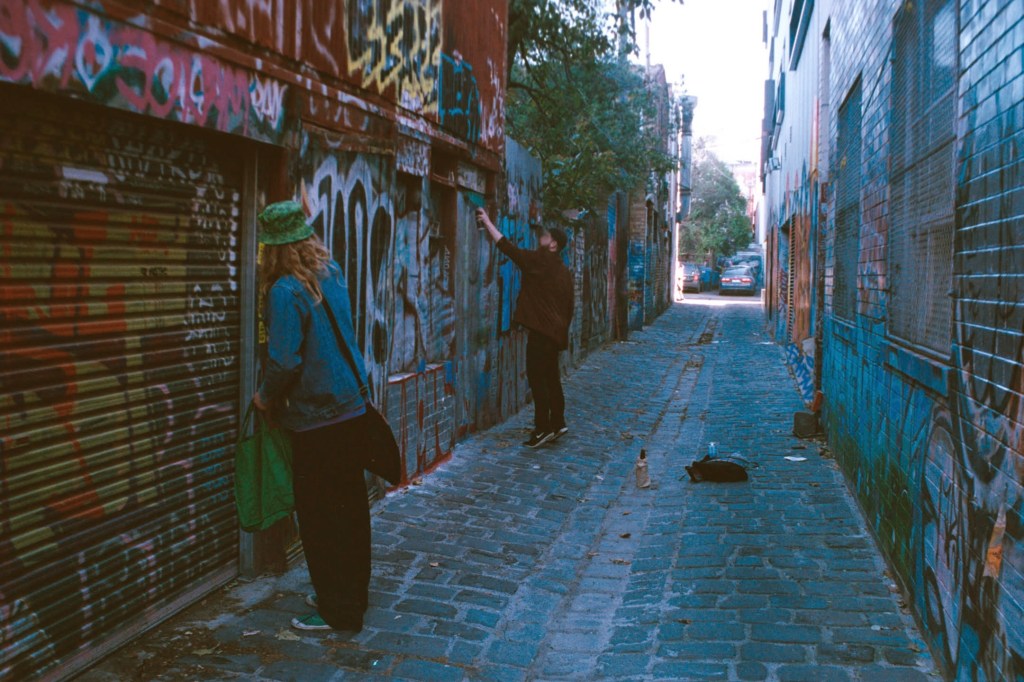
The Following was a write up I did in 2020 about the Melbourne Street art scene. This was written before I left for Canada, and before I’d shifted my own practice towards including murals as artworks that I took seriously.
At the time I was painting pretty regularly with the emphasis on making things that I thought would be funny to show friends. The following was found on an old hard drive that I stumbled across recently. I’ve included some notes from today at the end.
Thoughts on the Melbourne scene by someone who wasn’t asked for their opinion
I’ve been participating in the Melbourne street art scene since my teenage years; over 10 years now. It was the energy that surrounded the scene that led me to where I am now as an artist.
It felt like I caught the tail end of a golden era. Maybe this was the case; or maybe it was feeling like I’d discovered a subculture during puberty.
.
Either way, I discovered this subculture had local legends and myths, sacred places, and its own lingo. People in the scene were three-dimensional characters. I saw some who served as role models going forward and some who struggled with their vices. Plenty fit the description of someone that – as a kid – I was warned to stay away from.
Memories of those early days stay with me. Key experiences that shaped me.
Climbing rooftops to put up posters, doing really messy tags and having no can control. Getting cornered for my paint by some older graffiti types with boxcutters. Painting up a ladder at a mate’s warehouse, dropping a can that burst over a piece underneath, having to run down the street to the bottle store to buy the writer some beers.
The sense of community was really tight knit. We would exchange stories that we’d heard from other artists. “X crew beat up X writer because they painted the wrong spot”. “X saw Jisoe down Bourke Street being weird”. “Did you hear about the abando with a bunch of squatters that we painted recently?”
I think the myth-building was something that really drew me in. I watched videos of Melbourne’s train graffiti and it excited me.
At the time street art was gaining popularity but it hadn’t hit a critical mass yet. You’d still cop a chase from some hero down the street; and the only “street art celebrity” was Banksy – and even then, a lot of normies still didn’t know who he was.
I felt a lot of people painting were dropkicks and social rejects who bonded over a shared interest of leaving a mark where they weren’t allowed. I felt like I belonged.
Today, I feel the scene often feels shallow and at times embarrassing.
A scene that used to be fueled by the rush of being counter-cultural wasn’t killed by zero tolerance policies or strict fines. Instead it’s been saturated by popularity and used as an easy marketing trope, and has eaten itself from the inside.
“Street Art” is a label that describes art that was put on walls without curation or permission. This is why people argue that street art inside a gallery context cannot work. You can have work inspired by street art, or by artists who often participate in the street art scene, but given the context, it doesn’t fit the criteria to call it street art.
Another issue that’s risen is artists doing public murals. Artists that used to participate in the act of putting up unsolicited images around the neighbourhood are now getting commissions in the public space. Are these works street art or just public art with spin?
The term “Street Artist” now invokes cringe every time I hear someone refer to themselves as one. Most people who cling to this title are doing so because for them it’s a crutch, either consciously or not, they realise their work can’t stand on its own, so they grasp for a title that distracts from their forgettable art. If you removed the street art title from most of these artists their work falls short. These artists will only ever put work in legal, designated areas and galleries. If you see their artwork pop up, it’s often a month or so before an exhibition to remind people that they’re not your average run-of-the-mill artist – they’re a street artist. You won’t ever see them actually risk anything for their work.
In my opinion, artists worth any respect that participate both in the street art scene and in galleries tend to refer to themselves simply as artists or painters. Most of the ones I enjoy the most avoid picking out labels for themselves, they’re too preoccupied with what they need to do, create stuff.
I don’t have a great solution to fix the scene, as I don’t think the scene needs fixing. I think it needs time to cool off and lose some of its popularity for a while.
If you go to any of the prominent street art lanes around the city, you may notice that it’s a circus. Advertising firms have realised that instead of paying for a billboard you can pay artists less, for more exposure. People will take a photo in front of your painted ad and post it to their socials. Sudden exposure! But tourists often don’t see the deeper advertising content behind it. I once saw a dark suicide awareness campaign painting of a suicide note and a limp hand next to it. Tourists were still taking selfies in front of it; they had no interest in what was painted or the themes represented.
People get their wedding photos and tourist shots taken in Hosier lane because its predictably colourful, and now with the addition of Culture Kings, they can spend some money getting some “Streetwear”.
I feel like given enough time the scene will slowly fizzle out and lose popularity. Those who are actually passionate about it will stay, while those who are just chasing hype will move on to the next thing.

